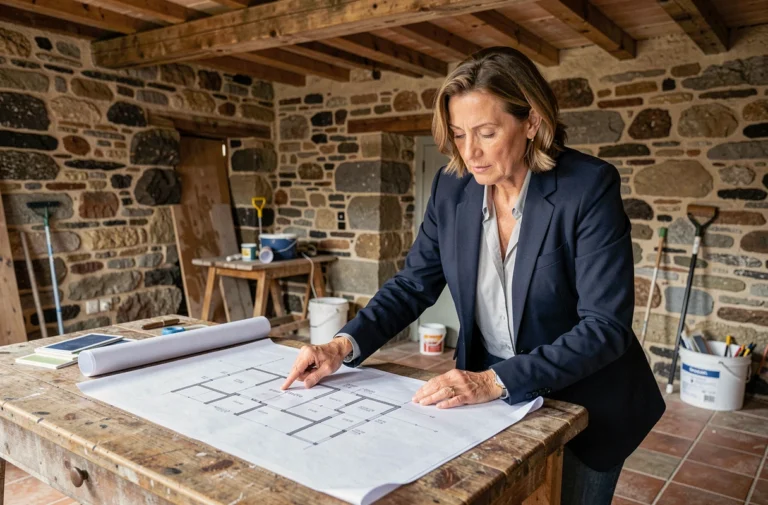
Successfully completing a home project relies less on manual skill and more on the method employed even before touching a tool. The majority of domestic projects that get bogged down share the same causes: vague time estimation, incomplete purchases, and material incompatibilities discovered along the way. Establishing a solid technical framework in advance radically changes the course of the work, whether it’s about a custom shelf or a bathroom renovation.
Feasibility of a home project: what can be done by oneself and what cannot
Before planning anything, the first question to address is the limit of feasibility in DIY. Not all home projects are created equal. Installing laminate flooring, replacing a faucet, or erecting a drywall partition: these tasks are documented, the materials are standardized, and mistakes can be corrected.
On the other hand, working on a load-bearing wall, intervening on an electrical panel, or modifying a gas line requires regulated skills. It’s not a matter of courage; it’s a matter of compliance and safety. A poorly executed electrical connection may not be visible, but it can jeopardize home insurance in the event of a disaster.
The distinction is not always obvious. Some operations seem simple (moving an outlet, drilling a wall) but involve hidden constraints (technical ducts, load-bearing structures, embedded piping). Taking the time to check the nature of the support and the layout of the home avoids costly surprises. Several practical guides detail these limits, and Ben Le Bricoleur’s home articles address such concrete cases with useful field feedback.

Preparing the site: the steps that most DIYers skip
Recent specialized content emphasizes one point: preparation matters more than execution. Checking technical constraints, listing materials with their exact references, anticipating the order of steps—all of this is done before opening a can of paint.
Framing the project in writing
A scaled sketch, even rudimentary, changes the game. It allows for calculating surfaces, identifying obstacles (outlets, pipes, non-right angles), and ordering the right quantities. Drawing does not require architectural skills; a tape measure and a grid sheet are sufficient.
Formalizing the action plan in writing encourages sequencing operations in the correct order. Painting a ceiling after laying a floor, for example, generates additional protections and unnecessary stress. The logical sequence of tasks is not always intuitive, especially when multiple trades intersect.
Listing materials and tools before any purchase
One of the most common blockages on a home project is incomplete purchasing. A specific screw, a sealing gasket, a drill bit is missing. The project halts, and motivation drops.
- Create a complete list of materials with dimensions and references, not just generic names (“some dowels” is not enough; the diameter, length, and type of support are needed).
- Check the compatibility of products with each other: some adhesives do not hold on certain supports, and some coatings cannot be applied to damp surfaces.
- Allow for a margin on consumables (screws, glue, joint tape) to avoid interrupting the project for a missing tube.
This step may seem tedious. However, it saves several hours on the total duration of the project.
Time estimation: the most underestimated variable in DIY
Field feedback converges on one observation: the necessary time is almost always underestimated. An occasional DIYer will easily take twice the expected time for an operation they are discovering. Even an experienced DIYer encounters unforeseen circumstances (damaged support under an old covering, slightly skewed measurement, faulty tool).

Planning broadly rather than tightly protects morale and the quality of the result. A weekend planned to tile a small room may suffice if everything goes well, but allowing for a half-day margin absorbs the unforeseen without turning the project into a source of frustration.
The other common trap is multiplying projects in parallel. Opening three simultaneous projects in an occupied home creates permanent disorder and dilutes attention. Completing one project before starting another yields better results, including in terms of motivation.
Choosing materials and tools: favor the appropriate over the versatile
The temptation for versatile equipment is strong, especially when the budget is limited. A tool that does everything rarely does anything very well. For a one-off project, renting a specialized tool (miter saw, belt sander, heat gun) costs little and offers a clean result.
- Entry-level materials are sufficient for a trial or a low-demand room, but a cheap laminate countertop installed in an active kitchen will show its limits in a few months.
- Solid wood tolerates cutting errors better than melamine, which easily chips at the edges. Choosing the material based on its tolerance for adjustments changes the comfort of work.
- Mechanical fasteners (screws, bolts) are often more reliable in the long term than adhesives, especially on elements subjected to vibrations or loads.
Adapting the choice of material to the level of use of the concerned space avoids early repairs. A high-traffic hallway does not tolerate the same finishes as a closed dressing room.
The available data do not allow for a definitive budget type, as projects vary widely in scope. However, dedicating a portion of the budget to appropriate tools rather than an excess of decorative materials improves the quality of execution over time.
The factor that separates a successful home project from a halfway abandoned one is rarely technical skill. It is the rigor of preparation, the realism in time estimation, and the choice not to start until the materials list is complete. These reflexes are acquired project after project, provided one takes the time to analyze what has worked and what has stumbled each time.