
The men’s 100 meters world record is 9.58 s, set by Usain Bolt on August 16, 2009, during the World Championships in Berlin. On the women’s side, Florence Griffith-Joyner holds the benchmark at 10.49 s since July 16, 1988, in Indianapolis. Both performances are still recognized by World Athletics, the international body that validates athletics records.
Average Speed and Peak Velocity over 100 Meters
A time of 9.58 s over 100 meters corresponds to an average speed of 37.58 km/h. This figure, as impressive as it is, masks a biomechanical reality: the sprinter does not reach this pace uniformly.
The start and acceleration phase, over the first 30 to 40 meters, is run at a speed well below the average. The peak velocity typically occurs between the 60th and 80th meter. During his race in Berlin, Bolt maintained his maximum speed over an unusually long stretch, which partly explains the gap with his competitors.
The wind condition during this final, measured at +0.9 m/s, was well below the regulatory limit of +2.0 m/s. The world record for the 100m in athletics was therefore achieved under moderate wind conditions, without any particular aerodynamic assistance.
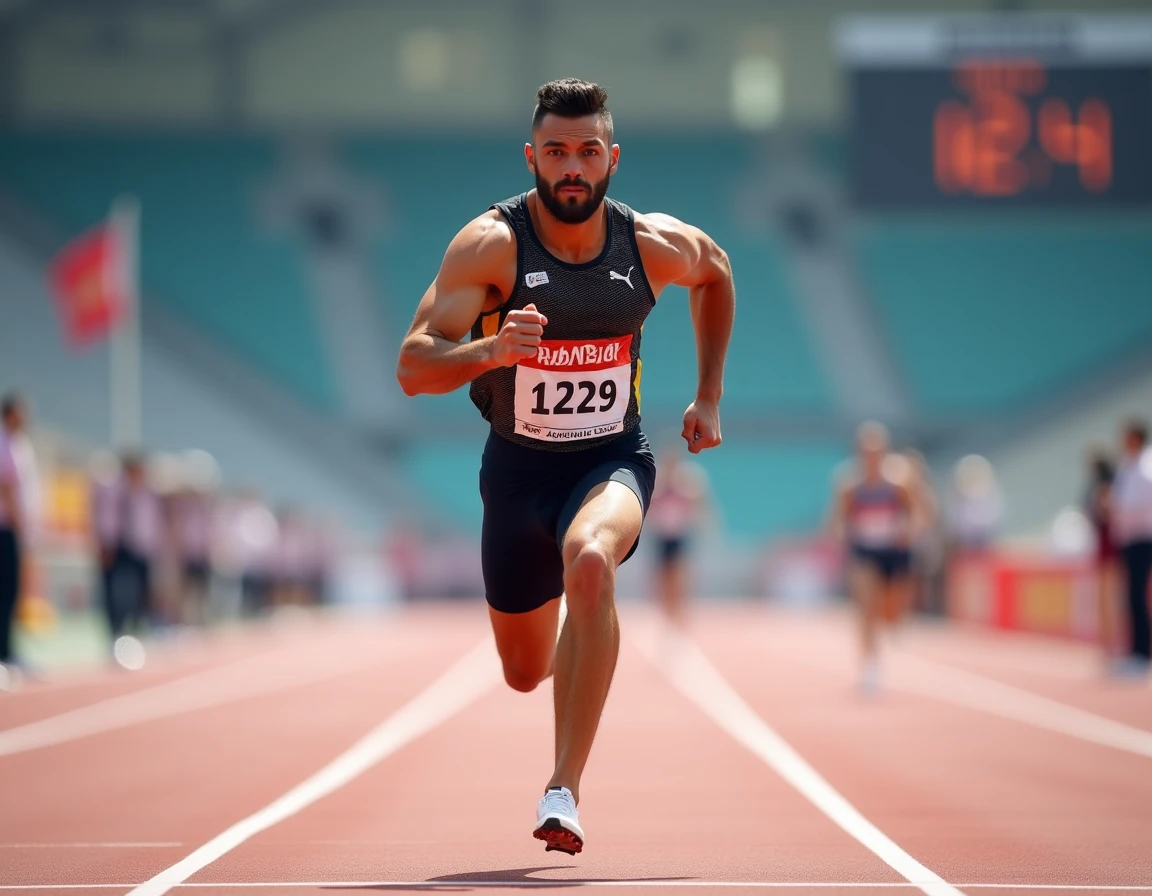
Usain Bolt: Achievements and Dominance in World Sprinting
Usain Bolt, born in Jamaica, dominated sprinting for a full decade, from 2008 to 2017. His career in the 100 meters is not limited to a single time.
- Triple Olympic champion in the 100 m (Beijing 2008, London 2012, Rio 2016), an unprecedented feat in the history of this event.
- Double world champion in the 100 m and simultaneous holder of the world records in both the 100 m and 200 m (19.19 s in Berlin in 2009).
- His events also included the 4×100 m relay, where he contributed to several world and Olympic titles with the Jamaican team.
His active period at the highest level, from 2008 to his retirement in 2017, coincides with an era where no other sprinter has approached 9.58 s. The best times recorded by his rivals remain several hundredths away from this mark.
An Unusual Build for Sprinting
Bolt stood about 1.95 m tall, a height significantly above the average for elite sprinters. This build gave him a longer stride but posed a theoretical disadvantage at the start, a phase where more compact athletes generally accelerate better. His ability to compensate for this initial handicap with an exceptional maximum speed phase is one of the biomechanical peculiarities of his career.
Women’s 100 m Record: Florence Griffith-Joyner’s Mark
The women’s record, held by Florence Griffith-Joyner since 1988, is one of the oldest sprint records still in effect. In over three decades, no athlete has come close to it in a significant way.
This record raises recurring questions in the athletics community. Two points fuel the debates:
- The wind measurement conditions during the Indianapolis race have been questioned, with some technical analyses pointing to a possible malfunction of the anemometer that day.
- The evolution of anti-doping protocols since 1988 is often mentioned, as the tests at that time were less sophisticated than those conducted today.
- Despite these discussions, World Athletics has never officially questioned this performance, which remains validated in the records.
This stagnation of the women’s record contrasts with the men’s record, where several generations of sprinters have gradually lowered the times down to Bolt’s mark.

Technological Evolution and Perspectives on the 100 m Record
Sprinting shoes have significantly evolved in recent years. The carbon fiber plates integrated into modern spikes change the energy return with each step. Bolt himself stated, during an event held before the 2025 World Championships, that with today’s shoes, he could have run even faster than 9.58 s.
This statement reignites a technical debate: what portion of the performance is attributable to the athlete, and what portion is due to the equipment? Modern spikes offer a rigidity and cushioning that models from the 2000s did not possess.
Bolt’s Successors in the 100 m
Since Bolt’s retirement in 2017, several sprinters have attempted to approach his mark. The best times recorded in recent years remain several hundredths away from the record. The barrier of 9.58 s seems currently out of reach, even with the advent of new shoe technologies.
World Athletics continues to update its official list of the best performances of all time in the 100 meters. This list serves as a reference to verify the status of records, beyond encyclopedic sources.
The 100 meters record remains, among all athletics disciplines, the one that attracts the most media attention. Its simplicity, a straight line run as fast as possible, makes it a universal benchmark for human speed. As long as the 9.58 s from Berlin remains unbeaten, Usain Bolt’s name will remain attached to this distance.